Masthead Data x Vodafone
How Vodafone Czech Republic Cut BigQuery Compute Costs by 30% on Day One with Masthead

Impact from day one
30%
reduction in BigQuery compute costs, validated on day one of optimization
Data stack
Google Cloud, BigQuery
Site
Industry
Telecommunications
Company size
1000 - 3000 employees
Founded
1999
We achieved a 30% reduction in BigQuery compute costs, on top of the 46% in savings we'd already secured by migrating from on-prem to BigQuery. BigQuery and Masthead are a perfect combination for us — the solution never accesses, reads, or modifies our data or environment in any way. The results were straightforward and clear. It also helped that the Masthead team walked us through how to work with reservations and tailored the solution to our enterprise requirements around network security and metadata processing.

Petr Vergara Čípa
Vodafone Czech Republic
Vodafone Czech Republic is part of the global Vodafone Group, providing mobile and fixed telecommunications services to millions of customers. Facing growing pressure to modernize, Vodafone CZ chose Google Cloud as its partner to build a data platform ready to serve AI, agents, and human users alike.
From the outset, the team — led by Petr Vergara Čípa and his manager — knew that cost discipline had to be part of the migration strategy from day one. As part of the move off on-premises infrastructure, the team identified that roughly 80% of their legacy data stack was technical debt not worth carrying into the new platform.

Petr Vergara Čípa and Yuliia Tkachova presenting the case at Google Cloud Summit Czech Republic how Vodafone C.Z. worked with Masthead to achieve visibility and cost efficiency of their data environment
The Challenge
The migration came with real pressure: a tight timeline and a large scale. Early on, the team recognized that BigQuery would make up the majority of their Google Cloud spend, and they wanted to get ahead of it rather than react to it later.
That wasn't simple. The team didn't yet have deep in-house expertise in optimizing BigQuery workloads, and cost wasn't the only constraint — they also had to meet business requirements around data delivery times and job duration. Compounding the difficulty, BigQuery usage during the migration was spread across more than 50 GCP projects, making it hard to get a consistent view of cost or performance.
On top of the scale itself, the team was navigating unfamiliar compute and billing models, along with the operational disruption that comes with any large migration — all while being expected to bring costs under control. BigQuery's per-job, incremental cost structure made it especially difficult to identify which levers would actually move the needle on spend.
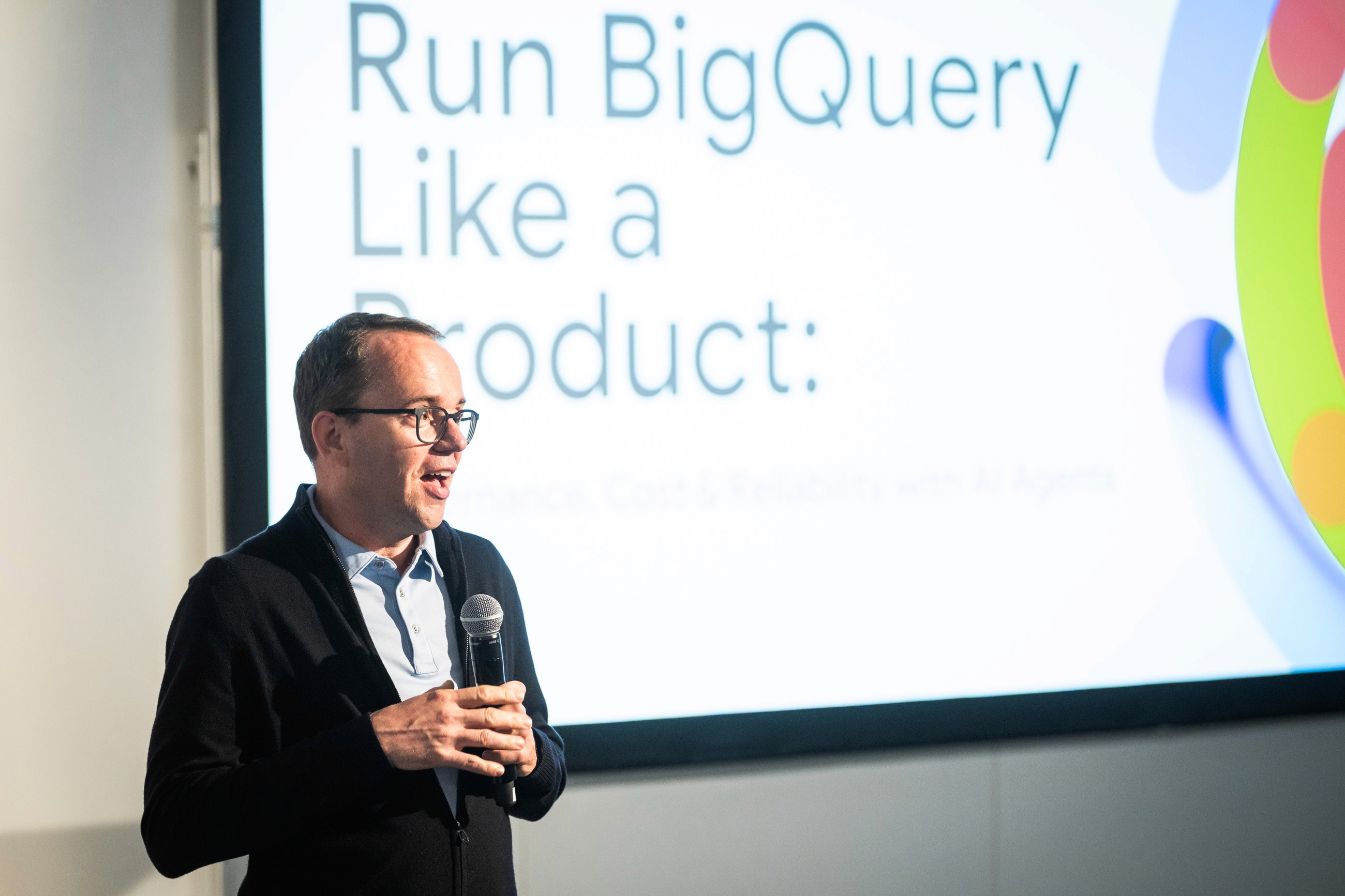
Tomasz Czarnecki, Data Analytics AI Product Specialist at Google Cloud announcing Yuliia’s talk: How to run BigQuery as a product
The Solution
When Vodafone CZ's team met Masthead, the value was immediately clear: full visibility across multiple BigQuery instances, with cost broken down by environment, pipeline, and model. For a team working across a distributed, fragmented environment, that level of granularity — and control — was exactly what had been missing.
Vodafone CZ deployed Masthead in 20 minutes via a single Terraform script. Within a few hours, the team had actionable insight in the Masthead UI, surfacing their major cost centers and concrete opportunities to optimize spend by right-sizing compute reservations to actual workloads.
From there, Masthead simulated workload patterns and recommended the optimal combination of pipelines and reservation sizes — balanced against the performance requirements each workload actually needed.
The Results
Vodafone CZ saw a 30% reduction in BigQuery compute costs on day one of optimization. The team was able to verify the savings directly and hit their cost targets without compromise.
Just as important: workload performance didn't degrade. Using Masthead's reservation strategy, the team added capacity where workloads needed it while reducing cost elsewhere — matching reservation size precisely to each workload's actual demand.